Fueling nascent democratic tools
Cotuí was one of six Dominican municipalities to participate in an exercise spearheaded by Barrick to help communities allocate mining revenue in a democratic and transparent manner. These municipal development plans (MDPs) stem from a 2007 Dominican law that stipulates local governments must invest funds provided by the central government and/or private investment through a democratic budgeting process. In 2009, Cotuí and the neighboring municipalities of Maimón and Fantino approved their respective MDPs in local referendums. Since then, three more nearby municipalities have adopted MDPs.
Once the people of Cotuí determined how they wanted to invest their funds, Barrick signed the voluntary cooperation agreement to fund construction of some of the infrastructure projects outlined in the community’s MDP.
“The community plays a very active role in the framework of the agreement we’ve signed,” says Welinton Otañez, Corporate Social Responsibility Supervisor at Pueblo Viejo. “We’ve established social auditing committees as well as assessment councils. People from the community sit on these councils and committees, and they’re responsible for evaluating the projects and ensuring they meet the community’s expectations.”
Those expectations in a place like Cotuí, which has grown rapidly in recent years—it is home to close to 80,000 people—can at times challenge the local government’s means.
“Barrick’s support is a strong stimulus for us as the authority in the community,” says Juan Francisco Luna, City Councilor in Cotuí. “We’ve been able to carry forward a series of projects that may have been impossible to execute just with our own resources.”
The Pueblo Nuevo Arena is just one example. The municipality and Barrick have partnered to build health centers, churches, water infrastructure projects, and community centers, amongst others. They’re currently in the planning stage to build a market for small vendors and a new cemetery.
At the root of the brick and mortar projects lies the evolution of a partnership that has been growing stronger over the past decade.
“Having a partner like Barrick is extremely important,” Luna says. “Saying that there isn’t a prosperous relationship between Barrick and the municipality, or that it hasn’t evolved, would be a great misrepresentation.”
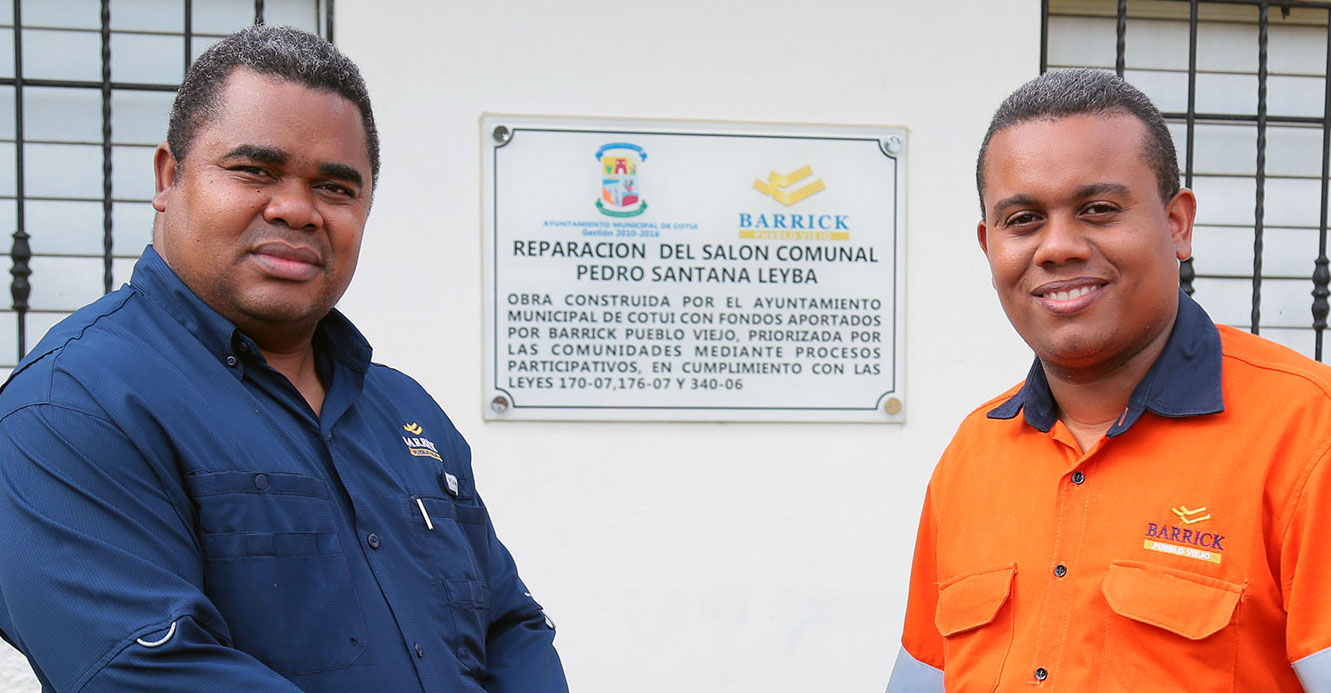
Welinton Otañez (left) and Jahaziel Serrano, members of Pueblo Viejo’s Community Relations team, were both born and raised in Cotui.
Rising together
When talking about the partnership between Barrick and Cotuí, Luna acknowledges there were some tense moments in the past. Questions about revenue sharing—the timing, amount and method of dispersal—didn’t always result in immediate agreement. Ultimately, however, these issues were overcome through continuous dialogue and engagement.
“When there’s a grievance and the other side understands, it’s easier to reach a consensus,” Luna says. “The differences we had at the beginning, born out of misunderstandings, no longer exist.”
Barrick’s cooperation agreement with Cotuí is the product of that understanding.
Another factor that has strengthened the relationship is a commitment from both sides to uphold high levels of transparency and put the community’s interests first.
A clear example is the announcement the authorities made during the inauguration of the Pueblo Nuevo Arena. On that day, Teresa Ynoa Soriano, the Mayor of Cotui, stated that the municipality would assume responsibility for the maintenance of the new facility.
“It’s something we see constantly: the authorities’ desire to ensure that the community benefits above anything else,” Otañez says.
City councilors, meanwhile, point to Pueblo Viejo’s open-door policy as an example of the operation’s efforts to be as transparent as possible. Gladys Mercedes Soto, Human Resources Manager for the municipality, says she’s witnessed the effect of welcoming locals inside the operation. Soto, who is also a Professor of Environmental Law at the Eastern Cibao Technological University, explains that whenever her students talk about contamination from the mine during her lectures, she encourages them to take advantage of Pueblo Viejo’s organized tours, which are open to the public.
“I think that’s extremely important, that social aspect; opening the doors and welcoming anyone who wants to see,” Soto says. “After the tour, they often become Barrick advocates.”
Beyond these principles that the two sides uphold, there’s an important element that brings them closer together: a deep love for the community where they were born.
From the community for the community
“From my perspective, the strong relationship that both institutions enjoy is due to the fact that a large number of people who work for Pueblo Viejo’s community relations team are from the communities,” Paulino, Cotui’s City Treasurer, says. “For instance, both Jahaziel Serrano and Welinton Otañez are guys we’ve grown up with. They bring the Company closer to the community.”
Serrano, Corporate Social Responsibility Coordinator at Pueblo Viejo, and Otañez were both born in Cotuí. As they walk around the Pueblo Nuevo Arena and explain its importance to the community, it’s easy to notice a sense of pride in the way they speak.
“Knowing that my uncles and parents fought during their youth to get a space like this one, and seeing 30 or 40 years later that their dream has become a reality, and that you’ve contributed to that, is priceless,” Otañez says.
The vast majority of the Pueblo Viejo team members who engage with the communities were born and raised in those communities, so they understand what the real needs are. They’re fully invested in their jobs, because they have to live with the results of their efforts, just as the rest of the community does. In Otañez’s case, Pueblo Nuevo, the neighborhood where the sports center is located, is where he and his parents grew up.
“Seeing an infrastructure project like this one and knowing that it was built with Barrick’s support is a remarkable thing for me,” he says. “I feel a great sense of satisfaction, not only because I am witness to it, but also because I was part of it.”
*Pueblo Viejo is jointly owned by Barrick and Goldcorp with Barrick holding a 60 percent interest and Goldcorp holding a 40 percent interest.